

432.4K
Downloads
3363
Episodes
G’day and welcome to Partakers Christian Podcasts! Join us for uplifting Bible teaching, inspiring readings, heartfelt worship, powerful prayers, and fascinating church history. Whether you’re new to faith or growing deeper in your journey, we’re here to encourage and equip you. 🎧 Tune in, interact, and be inspired—wherever you are in the world.
Episodes

Thursday Jul 31, 2025
Thursday Jul 31, 2025

Thursday with Tabitha
8. Habakkuk by Tabitha SmithThis week we’ve reached the book of Habakkuk. There’s an awful lot of wisdom and truth packed into the three short chapters of Habakkuk’s prophecy.
We don’t know much about the man Habakkuk himself. The way he writes his prophecy is unusual. It reads like a personal diary or journal and it takes the form of a conversation between Habakkuk and God. The intended audience was the people of Judah, but they are not directly addressed. The time of writing was around 620 BC so Habakkuk was a contemporary of Zephaniah and Jeremiah.
The book opens with Habakkuk crying out to God with a desperate question. The Message translation says it like this:
“God, how long do I have to cry out for help
before you listen?
How many times do I have to yell, “Help! Murder! Police!”
before you come to the rescue?
Why do you force me to look at evil,
stare trouble in the face day after day?
Anarchy and violence break out,
quarrels and fights all over the place.
Law and order fall to pieces.
Justice is a joke.
The wicked have the righteous hamstrung
and stand justice on its head.”
So Habakkuk asks the age-old question - God, why don’t you do something? Why are the bad guys getting away with it?
God comes right back at him with an answer he isn’t expecting. This would also have been something of a nasty surprise to the people of Judah who would have read Habakkuk’s words. God tells him that he is raising up the Babylonians (also known as the Chaldeans) to be his instrument of judgement on the people of Judah. The Babylonians were a nation of awesome and ruthless military power and an invasion by their army would have been an utterly terrifying prospect. God paints the picture of the dreaded and fearsome Babylonians setting their faces towards Judah.
Habakkuk replies to God with a sense of disbelief about what he’s just heard. He asks God how he can possibly use such an evil nation as the Babylonians to judge another people who are less evil. Habakkuk then sits and waits for God’s response. God replies again and tells Habakkuk to write the vision down as a mark of its importance and the certainty with which it will come to pass.
In the oracle that follows, God reveals to Habakkuk the bigger picture. He says in effect, yes, the Babylonians will come and yes, they will be my instrument of judgement on Judah. BUT, they will go too far in their punishment of Judah and so they too will be judged and held accountable for their deeds. The Babylonians are described as those who plunder, cheat and kill unscrupulously. They get drunk and take pleasure in the sadistic humiliation of their defeated enemies. Well, says God, they will reap the due rewards of their deeds and they will be judged.
In Habakkuk 2:16, God declares to the Babylonians: “The cup in the Lord’s right hand will come around to you, and utter shame will come upon your glory!”
The second chapter ends with the words “But the Lord is in his holy temple; let all the earth keep silence before him.” I imagine Habakkuk sitting, or perhaps lying face down, in stunned silence at the revelation he has just received.
In the final chapter we see Habakkuk going on an amazing journey of spiritual growth. God’s words have seized his faith and imagination and he now pours out a dramatic description of the image of God he sees, coming in awesome power and majesty to judge the earth.
In Habakkuk 3:16 - “I hear, and my body trembles; my lips quiver at the sound; rottenness enters my bones; my legs tremble beneath me. Yet I will wait quietly for the day of trouble to come upon people who invade us.”
Habakkuk is overcome by strength-sapping, gut-wrenching fear when he thinks about what lies ahead but he chooses to sit and wait for God to do what he has promised.
Firstly, that it is OK to ask God questions and to cry out to God about what we see happening in the world. When we don’t understand we need to ask God to help us. The answers God gives us may not be what we expect! Secondly, we learn again that God is sovereign and in control of all the events of history. He is just and good and he will not leave any evil unpunished. Nobody is getting away with anything. Thirdly, we learn that God can use even the most evil people and the most terrible circumstances to bring about his plans. God does not engineer the evil - people are responsible for their own decisions and actions, but God is always in control of the events of history. Joseph summarises this principle well at the end of the book of Genesis when he addresses his brothers: “Do not fear, for am I in the place of God? As for you, you meant evil against me, but God meant it for good, to bring it about that many people should be kept alive, as they are today.” (Genesis 50:19-20)
The crux of the book of Habakkuk is found in Habakkuk 2:4 - “the righteous shall live by his faith”. This verse is quoted no less than 3 times in the New Testament by different authors to illustrate different aspects of the life of faith (You can find it in Romans 1:17; Galatians 3:11; Hebrews 10:38). Habakkuk learns that the secret to finding security and true joy in life is to trust in what God has promised. Faith is not a feeling, it is a deep confidence in what God has said. The writer of Hebrews expresses the same truth in Hebrews chapter 11:1: “Now faith is the assurance of things hoped for, the conviction of things not seen.”
This does not mean that faith guarantees comfort or safety. Faith may have to survive in situations of complete desolation and want. And this is the place Habakkuk is able to reach at the end of his prophecy. In his final prayer he says: “Though the fig tree should not blossom, nor fruit be on the vines, the produce of the olive fail and the fields yield no food, the flock be cut off from the fold and there be no herd in the stalls, yet I will rejoice in the LORD; I will take joy in the God of my salvation.” Habakkuk 3:17-18
So Habakkuk says, if God never does another good thing for me, and never provides me with any other provision for the whole of my life, he is still absolutely worthy of my praise for the rest of eternity. And this is the key for us too. If God never blessed us with another thing in the whole of our earthly lives, Jesus would still be enough to rejoice about for the rest of eternity. We have more than enough to give thanks to God for to allow us to find joy in all circumstances. If we can trust in his purposes, even when we cannot fathom them at the time, we will discover the way to irrepressible hope and strength, which is the essence of joy. It doesn’t mean we’re always happy, or that we cannot mourn and weep when terrible things happen. Distress and sorrow are absolutely appropriate responses to evil and disaster. But joy is a deeper undercurrent that can co-exist with even the deepest sorrow. It is the knowledge, in the depths of our souls, that God is good, there is hope, death is defeated and Jesus is alive. There is purpose and meaning in our lives because we are made to live in relationship with God for eternity.
Like Habakkuk we will then discover that God can lift us above our earthly perspective and give us a glimpse of the bigger picture. As Habakkuk says in his final words of the book: “GOD, the Lord, is my strength; he makes my feet like the deer’s; he makes me tread on my high places.” (Habakkuk 3:19)

Wednesday Jul 30, 2025
Wednesday Jul 30, 2025
Wednesday Wisdom
Proverbs 14
G’day! Welcome to Partakers and to Wednesday Wisdom, where we are listening to what the Bible has to say through the Wisdom literature of Proverbs, Ecclesiastes and Song of Solomon. Come on in! Today we are listening and learning from Proverbs 14
1 Every wise woman builds her house: but the foolish plucks it down with her hands.
2 He that walks in his uprightness fears the Lord: but he that is perverse in his ways despises him.
3 In the mouth of the foolish is a rod of pride: but the lips of the wise shall preserve them.
4 Where no oxen are, the crib is clean: but much increase is by the strength of the ox.
5 A faithful witness will not lie: but a false witness will utter lies.
6 A scorner seeks wisdom, and finds it not: but knowledge is easy to him that understands.
7 Go from the presence of a foolish man, when You perceive not in him the lips of knowledge.
8 The wisdom of the prudent is to understand his way: but the folly of fools is deceit.
9 Fools make a mock at sin: but among the righteous there is favour.
10 The heart knows his own bitterness; and a stranger does not intermeddle with his joy.
11 The house of the wicked shall be overthrown: but the tabernacle of the upright shall flourish.
12 There is a way which seems right to a man, but the end thereof are the ways of death.
13 Even in laughter the heart is sorrowful; and the end of that mirth is heaviness.
14 The backslider in heart shall be filled with his own ways: and a good man shall be satisfied from himself.
15 The simple believes every word: but the prudent man looks well to his going.
16 A wise man fears, and departs from evil: but the fool rages, and is confident.
17 He that is soon angry deals foolishly: and a man of wicked devices is hated.
18 The simple inherit folly: but the prudent are crowned with knowledge.
19 The evil bow before the good; and the wicked at the gates of the righteous.
20 The poor is hated even of his own neighbour: but the rich has many friends.
21 He that despises his neighbour sins: but he that has mercy on the poor, happy is he.
22 Do they not err that devise evil? but mercy and truth shall be to them that devise good.
23 In all labour there is profit: but the talk of the lips tends only to poverty.
24 The crown of the wise is their riches: but the foolishness of fools is folly.
25 A true witness delivers souls: but a deceitful witness speaks lies.
26 In the fear of the Lord is strong confidence: and his children shall have a place of refuge.
27 The fear of the Lord is a fountain of life, to depart from the snares of death.
28 In the multitude of people is the king’s honour: but in the want of people is the destruction of the prince.
29 He that is slow to wrath is of great understanding: but he that is hasty of spirit exalts folly.
30 A sound heart is the life of the flesh: but envy the rottenness of the bones.
31 He that oppresses the poor reproaches his Maker: but he that honours him has mercy on the poor.
32 The wicked is driven away in his wickedness: but the righteous has hope in his death.
33 Wisdom rests in the heart of him that has understanding: but that which is in the midst of fools is made known.
34 Righteousness exalts a nation: but sin is a reproach to any people.
35 The king’s favour is toward a wise servant: but his wrath is against him that causes shame.
That’s it for today! Come back every day to Partakers Podcasts to hear something to encourage and uplift you as a Christian disciple, regardless of where you are in the world. You can also purchase our books via Amazon at Pulptheology.com
Click or Tap here to listen to or save this as an audio mp3 file
Tuesday Jul 29, 2025
Tuesday Jul 29, 2025
Psalm 131 to Psalm 135
Often we hear the Psalms one by one, but today we offer you the chance to hear a group of Psalms read as a collection!
Psalm 131
A song of ascents. Of David.
1 My heart is not proud, Lord, my eyes are not haughty;
I do not concern myself with great matters or things too wonderful for me.
2 But I have calmed and quietened myself, I am like a weaned child with its mother;
like a weaned child I am content.
3 Israel, put your hope in the Lord both now and for evermore.
Psalm 132
A song of ascents.
1 Lord, remember David and all his self-denial.
2 He swore an oath to the Lord, he made a vow to the Mighty One of Jacob:
3 ‘I will not enter my house or go to my bed,
4 I will allow no sleep to my eyes or slumber to my eyelids,
5 till I find a place for the Lord, a dwelling for the Mighty One of Jacob.’
6 We heard it in Ephrathah, we came upon it in the fields of Jaar:[a]
7 ‘Let us go to his dwelling-place, let us worship at his footstool, saying,
8 “Arise, Lord, and come to your resting place, you and the ark of your might.
9 May your priests be clothed with your righteousness;
may your faithful people sing for joy.”’
10 For the sake of your servant David, do not reject your anointed one.
11 The Lord swore an oath to David, a sure oath he will not revoke:
‘One of your own descendants I will place on your throne.
12 If your sons keep my covenant and the statutes I teach them,
then their sons shall sit on your throne for ever and ever.’
13 For the Lord has chosen Zion, he has desired it for his dwelling, saying,
14 ‘This is my resting place for ever and ever;
here I will sit enthroned, for I have desired it.
15 I will bless her with abundant provisions; her poor I will satisfy with food.
16 I will clothe her priests with salvation, and her faithful people shall ever sing for joy.
17 ‘Here I will make a horn[b] grow for David and set up a lamp for my anointed one.
18 I will clothe his enemies with shame, but his head shall be adorned with a radiant crown.’
Psalm 133
A song of ascents. Of David.
1 How good and pleasant it is when God’s people live together in unity!
2 It is like precious oil poured on the head, running down on the beard,
running down on Aaron’s beard, down on the collar of his robe.
3 It is as if the dew of Hermon were falling on Mount Zion.
For there the Lord bestows his blessing, even life for evermore.
Psalm 134
A song of ascents.
1 Praise the Lord, all you servants of the Lord who minister by night in the house of the Lord.
2 Lift up your hands in the sanctuary and praise the Lord.
3 May the Lord bless you from Zion, he who is the Maker of heaven and earth.
Psalm 135
1 Praise the Lord. Praise the name of the Lord; praise him, you servants of the Lord,
2 you who minister in the house of the Lord, in the courts of the house of our God.
3 Praise the Lord, for the Lord is good; sing praise to his name, for that is pleasant.
4 For the Lord has chosen Jacob to be his own, Israel to be his treasured possession.
5 I know that the Lord is great, that our Lord is greater than all gods.
6 The Lord does whatever pleases him, in the heavens and on the earth, in the seas and all their depths.
7 He makes clouds rise from the ends of the earth;
he sends lightning with the rain and brings out the wind from his storehouses.
8 He struck down the firstborn of Egypt, the firstborn of people and animals.
9 He sent his signs and wonders into your midst, Egypt, against Pharaoh and all his servants.
10 He struck down many nations and killed mighty kings –
11 Sihon king of the Amorites, Og king of Bashan, and all the kings of Canaan –
12 and he gave their land as an inheritance, an inheritance to his people Israel.
13 Your name, Lord, endures for ever, your renown, Lord, through all generations.
14 For the Lord will vindicate his people and have compassion on his servants.
15 The idols of the nations are silver and gold, made by human hands.
16 They have mouths, but cannot speak, eyes, but cannot see.
17 They have ears, but cannot hear, nor is there breath in their mouths.
18 Those who make them will be like them, and so will all who trust in them.
19 All you Israelites, praise the Lord; house of Aaron, praise the Lord;
20 house of Levi, praise the Lord; you who fear him, praise the Lord.
21 Praise be to the Lord from Zion, to him who dwells in Jerusalem.
Praise the Lord.
Right mouse click or tap here to save/download these Psalms as a MP3 file
Monday Jul 28, 2025
Monday Jul 28, 2025

Exploring The Bible
41. Old Testament
Ezekiel - 590-573BC
G'day and welcome to our series, "Exploring the Bible" This is also the title of one of books, and is available on Amazon...
Key Verses:
- Ezekiel 36:24–26
- Ezekiel 36:33-35
Ezekiel preached to the people of Judah in exile in Babylon. Ezekiel uses prophecy, parables, signs and symbols to show God’s message to His exiled people. He prophesies that God will reassemble them and make them live again, which amounts to a prophecy of resurrection. The judgement of the days in which they live will lead to a future glory, when Israel will know that God is God.
Click or Tap here to listen to or save this as an audio mp3 file
Sunday Jul 27, 2025
Sunday Jul 27, 2025

Worship
I wonder what you think worship is! Is your view of worship too small? Worship is giving God alone (Psalm 19:2), the glory due His name in the beauty of His holiness (1 Chronicles 16:29), with reverence.
“Yes, ascribe to the Lord! The glory due his name! Bring an offering and come before him; Worship the Lord when clothed with holiness!” (1 Chronicles 16:29)
Worship is where through the use of the mind and the senses, honour and respect are directed towards God, “in spirit and in truth” (John 4:23-24)! Yet a time is coming and has now come when the true worshippers will worship the Father in the Spirit and in truth, for they are the kind of worshippers the Father seeks. God is spirit, and his worshippers must worship in the Spirit and in truth.’
Come and explore with us, more about what worship of God is, why God is to be worshipped and how the Christian should worship God!
Click or Tap here to listen to or save this as an audio mp3 file
Friday Jul 25, 2025
Friday Jul 25, 2025
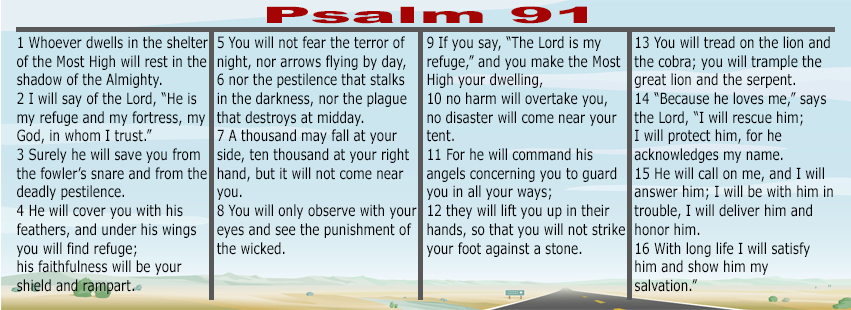
Psalm 91
91:1 He who dwells in the secret place of the Most High will rest in the shadow of the Almighty.
91:2 I will say of Yahweh, "He is my refuge and my fortress; my God, in whom I trust."
91:3 For he will deliver you from the snare of the fowler, and from the deadly pestilence.
91:4 He will cover you with his feathers. Under his wings you will take refuge. His faithfulness is your shield and rampart.
~
91:5 You shall not be afraid of the terror by night, nor of the arrow that flies by day;
91:6 nor of the pestilence that walks in darkness, nor of the destruction that wastes at noonday.
91:7 A thousand may fall at your side, and ten thousand at your right hand; but it will not come near you.
91:8 You will only look with your eyes, and see the recompense of the wicked.
~
91:9 Because you have made Yahweh your refuge, and the Most High your dwelling place,
91:10 no evil shall happen to you, neither shall any plague come near your dwelling.
91:11 For he will put his angels in charge of you, to guard you in all your ways.
91:12 They will bear you up in their hands, so that you won't dash your foot against a stone.
~
91:13 You will tread on the lion and cobra. You will trample the young lion and the serpent underfoot.
91:14 "Because he has set his love on me, therefore I will deliver him. I will set him on high, because he has known my name.
91:15 He will call on me, and I will answer him. I will be with him in trouble. I will deliver him, and honor him.
91:16 I will satisfy him with long life, and show him my salvation."
Right mouse click to save/download this Psalm as a MP3 file
Thursday Jul 24, 2025
Thursday Jul 24, 2025
Thursday with Tabitha
7. Zephaniah by Tabitha SmithThis week in our series on the minor prophets we are looking at the book of Zephaniah. Zephaniah was a contemporary of Jeremiah, Nahum and possibly Habakkuk and his prophecy was written during the reign of king Josiah of Judah. Josiah reigned between 640–609 BC. The prophecy includes reference to the future destruction of Nineveh, capital of Assyria, so it was likely written before the date of this event, which was 612 BC. The little territory of Judah was the only surviving part of the original people of Israel. The northern kingdom of Israel had been overthrown and Judah was under the control of the Assyrians.
King Josiah was a good king who undertook significant religious reform in Judah, trying to turn the people back from worshipping idols to worshipping their God. Josiah’s father, Amon, had been a wicked king, and his grandfather, Manasseh, was one of the worst kings in the history of Judah, doing evil in God’s sight and turning the people away from God. The king before Manasseh was called Hezekiah. We read his story in the book of Isaiah.
Zephaniah 1:1 provides us with Zephaniah’s family history. This is traced back as far as his great, great grandfather, Hezekiah. It is possible that this was the same king Hezekiah, meaning that Zephaniah came from a royal family.
One of the main themes of the book is the coming of the Day of the Lord. This is a phrase that appears many times in the Bible, referring to a day of judgment that would bring terror for God’s enemies and blessings for those who belong to God. Many prophetic oracles in the Bible have an element of immediate historical fulfilment in the day they were written, and another more distant application in a time yet to come. Zephaniah’s writings are no exception.
In Zephaniah 1, the prophecy launches straight into a devastating description of coming judgement. This is portrayed as an apocalyptic event, reversing the very order of creation and sweeping away both man and beast. But the focus zooms in very quickly to the people of Judah and Jerusalem, and in Zephaniah 1:4 we learn about some of the things the people of Judah were doing to incur such judgment: they were worshipping Baal, worshipping the heavenly bodies, pretending to worship God but trusting instead in the pagan god Milcom. They were turning away from God and ignoring him entirely.
God levels two main accusations against his people. The first is one of syncretism. This means mixing acts of service to God with pagan religious elements. In chapter 1 verse 8 the king’s sons and officials are described as wearing foreign clothes, probably associated with other religions, and in verse 9 the curious reference to people ‘leaping over the threshold’ probably refers to another pagan custom. You can read about the possible background to this practice in 1 Samuel 5:1-5.
The second accusation of God against his people is that they have become complacent in sin. The Judeans had started to think that God didn’t really involve himself in their daily lives, so it didn’t really matter how they lived. They had reduced God in their minds to a distant, impotent deity. The prophecy describes God going through Jerusalem personally, with search lamps, to find these complacent people and punish them.
The second half of Zephaniah 1 contains a fearsome description of the Day of the Lord as a day of great darkness, distress, wrath and ruin. Nothing will be able to protect human beings, not all the wealth they have collected. They will be reduced to nothing.
Thankfully, the book doesn’t end there! In Zephaniah 2 the people of Judah are told that repentance is still possible. This is surely good news after the terrible picture painted in chapter 1. The people are warned that the day of judgement will come quickly so they need to gather together and repent, to humble themselves and seek God.
“Seek the Lord, all you humble of the land,
who do his just commands;
seek righteousness; seek humility;
perhaps you may be hidden
on the day of the anger of the Lord.”
The word ‘perhaps’ might initially suggest that Zephaniah has doubts about whether God can indeed forgive any of the people. But in fact, this statement shows that Zephaniah understands and respects God’s sovereignty. God is able to forgive, but whether he does or not is entirely up to him. Any mercy he shows to the repentant is still entirely undeserved grace.
The rest of Zephaniah 2 contains a series of oracles of judgment against the nations that surround Judah, the enemies of God’s people. The cities of Gaza, Ashkelon, Ashdod and Ekron are Philistine cities to the west, along the Mediterranean coast. Moab and the Ammonite territory lie to the east. The Cushites originate from Ethopia and Egypt in the south, and Assyria lies to the north. The comprehensive description of judgment extending to the four corners of the known world includes the promise that God will return parts of these lands back to Judah and there is a hint of restoration to come.
However, before the people get too complacent again, Zephaniah 3 contains a hard-hitting denouncement of the city of Jerusalem, the capital of Judah. The people of God need to learn that they are not immune from God’s judgment of sin and they are just as accountable, if not more, than the pagan nations around them. The charges against the judges, officials, prophets and priests of Judah are pretty damning. They are corrupt, polluted, defiled.
“The Lord within her is righteous;
he does no injustice;
every morning he shows forth his justice;
each dawn he does not fail.”
So judgment is inevitable and unavoidable. God must be just and repay sin with punishment. But there is good news to come. Zephaniah 3:9 suddenly introduces a startling promise of hope. God says that there will be a day when he will change the speech of his people and make it pure again. The people will call out to God once more, they will serve him and he will restore them. A picture of unity, peace and holiness follows.
The last 6 verses of the book contain the most glorious and beautiful image of God delighting and rejoicing over his restored people. The judgement is finished, the shame is gone and restoration is possible. God does not delight in judgment, he delights in being in the midst of his people.
a mighty one who will save;
he will rejoice over you with gladness;
he will quiet you by his love;
he will exult over you with loud singing.
This final prophecy seems to refer to a future time of unity and peace for God’s people. In the short term, Judah was punished and judged when the Babylonians overthrew the Assyrians. Jerusalem was taken, and many of the people were carried off into captivity. After the exile, there was a degree of restoration and some of the exiles returned to Jerusalem to rebuild the city and its walls. But the picture of complete peace and restoration was not yet fulfilled. The gathering of all God’s people, the salvation of those who are lame and broken, and the rehoming of the outcast, is something we can still look forward to.
So what do we take away from the book of Zephaniah? We are reminded of the reality of the Day of the Lord that is still to come. Jesus warned that this day of final judgment would come suddenly, like a thief in the night, and many will be unprepared. We don’t want to be like the complacent Judeans, thinking that God wouldn’t involve himself in the reality of human affairs. Jesus is coming back!
The humble people amongst the remnant of Judah hoped that their repentance might not be too late. They threw themselves upon God’s mercy. For us, living in the light of Jesus’ cross, it is because of Jesus that we can know with assurance that we do not need to fear this coming Day of the Lord. If you have believed and trusted in Jesus, there is no “perhaps” about it. Jesus has taken upon himself the judgment that would have been yours and mine and we can be certain that there is no more condemnation.
The Day of the Lord will be a day of stark contrasts. This day will be terrible for those who have lived lives separated from God, in denial of him or in opposition to him. But for those who have humbled themselves and chosen to live under his authority, it will be a day of great joy, when God comes to dwell in the midst of his people. God will sing to us, his people! He will rejoice over us. What an amazing thought! The choices we make now have eternal consequences.
I’ll finish with the words that James writes in his New Testament letter: "You adulterous people! Do you not know that friendship with the world is enmity with God? Therefore whoever wishes to be a friend of the world makes himself an enemy of God. Or do you suppose it is to no purpose that the Scripture says, 'He yearns jealously over the spirit that he has made to dwell in us?' But he gives more grace. Therefore it says, 'God opposes the proud, but gives grace to the humble.' Submit yourselves therefore to God. Resist the devil, and he will flee from you. Draw near to God, and he will draw near to you. Cleanse your hands, you sinners, and purify your hearts, you double-minded. Be wretched and mourn and weep. Let your laughter be turned to mourning and your joy to gloom. Humble yourselves before the Lord, and he will exalt you!" (James 4:4-10 ESV)
Right Mouse click or tap here to download this episode as an audio mp3 file
Tuesday Jul 22, 2025
Tuesday Jul 22, 2025
Psalm 106 to Psalm 110
Often we hear the Psalms one by one, but today we offer you the chance to hear a group of Psalms read as a collection!
Psalm 106
1 Praise the LORD.
Give thanks to the LORD, for he is good;
his love endures for ever. 2 Who can proclaim the mighty acts of the LORD
or fully declare his praise?
3 Blessed are those who act justly,
who always do what is right.
Psalm 107
1 Give thanks to the LORD, for he is good;
his love endures for ever.
2 Let the redeemed of the LORD tell their story –
those he redeemed from the hand of the foe,
3 those he gathered from the lands,
from east and west, from north and south.
Psalm 108
A song. A psalm of David
1 My heart, O God, is steadfast;
I will sing and make music with all my soul.
2 Awake, harp and lyre! I will awaken the dawn.
3 I will praise you, LORD, among the nations;
I will sing of you among the peoples.
4 For great is your love, higher than the heavens;
your faithfulness reaches to the skies.
5 Be exalted, O God, above the heavens;
let your glory be over all the earth. ,
Psalm 109
For the director of music. Of David. A psalm.
1 My God, whom I praise, do not remain silent,
2 for people who are wicked and deceitful
have opened their mouths against me;
they have spoken against me with lying tongues.
3 With words of hatred they surround me;
they attack me without cause.
4 In return for my friendship they accuse me,
but I am a man of prayer.
5 They repay me evil for good,
and hatred for my friendship.
Psalm 110
Of David. A psalm.
1 The LORD says to my lord:
‘Sit at my right hand until I make your enemies
a footstool for your feet.’
2 The LORD will extend your mighty sceptre from Zion, saying,
‘Rule in the midst of your enemies!’
3 Your troops will be willing on your day of battle.
Arrayed in holy splendour, your young men will come to you
like dew from the morning’s womb.
Right mouse click or tap here to save/download these Psalms as a MP3 file
Thursday Jul 17, 2025
Thursday Jul 17, 2025
Thursday with Tabitha
6. Nahum by Tabitha Smith
Nahum prophesied about the destruction of the city of Nineveh, the capital of the nation of Assyria. If Nineveh sounds a bit familiar, it might be because you’ve listened to the first instalment in this series about the book of Jonah! In some ways, Nahum is like a sequel to Jonah.
The date of writing of Nahum can be narrowed down to somewhere between 660 BC and 630 BC. We can deduce this because of the historical events that Nahum refers to during his prophecy (unless of course you don’t believe in predictive prophesy!). Like Micah last week, we don’t know anything about Nahum apart from the fact that his home town was called Elkosh. It’s not certain where this was, but it was probably in Judah because at the time of his prophesy, the kingdom of Israel had ceased to exist.
The ten tribes of the Northern Kingdom of Israel had fallen to the Assyrians in about 722 BC. The Southern Kingdom of Judah had not suffered the same fate, despite an attempted siege of Jerusalem by Sennacherib of Assyria shortly after the fall of Samaria. Instead, the Kingdom of Judah had become a sort of vassal state to Assyria. The Assyrian kingdom had been established by acts of terrible violence, torture and cruelty and forced deportations of thousands of people, under the leadership of Tiglath-pileser III. His campaigns were ruthless and highly successful, conquering most of the known world at the time.
Nineveh was a great city, the capital of Assyria. Jonah had been sent by God with a message of warning to Nineveh, telling of God’s imminent judgement on them for their evil behaviour.
At that time, much to Jonah’s surprise and disgust, the people of Nineveh did repent and God spared them. However, a century later, we see that the repentance did not last, and Nineveh has fallen back into evil, idolatry, violence and depravity.
Nahum’s key message is that God is going to judge and overthrow Nineveh. Nahum means ‘comfort’ and his message would have brought comfort to the people of Judah who were living under Assyrian oppression.
Nahum is written in the style of ancient war poetry. The first verse of the book tells us that Nahum received the prophecy in the form of a vision. The way he writes his book is like the eye-witness account of a war correspondent. God is pictured as a divine warrior, coming to judge the Assyrians for their evil deeds. God had used Assyria as a tool of judgement on his own people, but the Assyrians were held accountable for the wicked nature of their conquests and the ways they had lived their lives in alienation from God.
In chapter one, the book opens with a poetic description of God on the war-path. God is described as jealous (for his honour and his people), wrathful, righteously angry and all powerful. Even the rock-solid mountains melt before him and the seas dry up completely. Nothing and no-one can stand against him. At the same time, God is also described as slow to anger, good, knowing those who seek him, compassionate and seeking his people’s freedom from their oppressors. The message that Nahum proclaims is simultaneously terrible and wonderful, and it all depends on the reader’s perspective and relationship to God.
At the end of Nahum 1, Judah is urged to keep the feasts, i.e. the celebrations of their history that remind them of God’s salvation purposes and commemorate his saving works for them in the past. Judah will be restored once more. We should not miss the significance of this - the Messiah would one day come from the remnant of Judah.
Nahum 2 launches into a prophetic account of the overthrow of Nineveh. The imagery is vivid and it’s almost as if Nahum is present in the city, watching the events unfold. The invading army arrives in the outskirts of Nineveh and the call goes out to ‘man the walls’ and take up arms. The invasion comes with speed and devastation, chariots thundering and swords and spears flashing and glinting in the sun. The invading soldiers are clothed in red with red shields, possibly indicating the original colour of the shields or their staining with blood. Siege towers are built and the river gates are opened to flood the city and destroy the royal palace.
It’s helpful here to consider what we know from historical accounts of the overthrow of Nineveh. Nineveh was attacked by a coalition of armies, principally of the Medes and Babylonians, in 612 BC. The city was sieged for a period of time which may have been as short as a few months. The invading armies closed the gates of the river Khoser, which flowed through the city, allowing the water to build up. The gates were then opened, unleashing a flood on the city which destroyed much of the important architecture and allowed the invaders to penetrate the city walls and finish the overthrow of the city.
Nahum 2 contains more vivid images of the invasion with graphic descriptions of the piles of dead bodies in the streets of the city. God asks Nineveh whether she has considered herself better than Thebes. Thebes was a great city in Egypt which was invaded by the Assyrians in about 664 BC. Thebes had appeared to be immune to attack with a natural sea defence and many allies. However, the Assyrians had conquered the city. They were now going to get a taste of their own medicine.
The book ends with Nahum surveying the aftermath of the siege and invasion. The final words are a taunting song declaring the finality of the destruction.
The ruins of Nineveh can be found today near the modern Iraqi city of Mosul. They were not discovered until the 19th century - prior to this all reference to Nineveh disappeared from the pages of history. When the ruins of the city were uncovered, many unburied skeletons were found. The city was razed to the ground. Nahum’s prophesies were fulfilled.
The book of Nahum reminds us that God is all powerful, omnipotent. He is not a tame god who is passive and powerless but he acts on behalf of his people. He is a God of justice who cannot pass over sin and evil but he must act justly to uphold his own honour and the welfare of his chosen people Israel. Moreover, God had promised to spare a remnant of his people, specifically from the tribe of Judah, in order that the Messiah, the deliverer, would come from his people. The future of the people of Israel often seemed under threat but God always faithfully preserved and restored a remnant to preserve the line of Abraham.
God is able to work even the most impossible of circumstances and most wicked of people into his sovereign plan. The seemingly ordinary list of names in the genealogy of Jesus described in Matthew chapter 1 encompasses accounts of infertility, prostitution, bereavement, displacement, adultery, murder and exile. God truly is able to make all things work for the good of those who love him, according to his purpose (Romans 8:28).
God can even use wicked and pagan people in order to judge his own people and work for their ultimate good. In a few weeks’ time we will look at this issue in more detail as we look at the way Habakkuk wrestled with this.
Whatever opponents or battles you face in your lifetime, none of them are too big for God to handle. The military might of the Assyrians was legendary and they built one of the greatest empires the world has ever seen. Yet even they were relegated to the pages of history, the ruins of their prized capital city lying undiscovered for centuries. Our perspective is so limited. We struggle to comprehend the span of human history, and yet humans are such a brief vapour, like the dew that evaporates from the morning grass. Peter says in the first chapter of his first letter:
“All people are like grass, and all their glory is like the flowers of the field; the grass withers and the flowers fall, but the word of the Lord endures forever.” 1 Peter 1:24-25
All earthly things will pass and only God will endure. Yet, incredibly, he cares about each one of us and knows every detail about us. The whole of history is centred around the life of Jesus, God in the flesh, who came to rescue us. Jesus is the Alpha and the Omega, the beginning and the end. He stands in authority above all human institutions and authorities, both the good and the evil ones. His kingdom is incomparably greater than the most mighty of human kingdoms and yet it is established in an upside-down order where the first are last and the last are first. We pray “your kingdom come on earth as it is in heaven” because Jesus has been given all authority in heaven and on earth. One day his kingdom will be unified and complete.
Then, as Paul says ‘at the name of Jesus, every knee will bow, in heaven and on earth and under the earth and every tongue confess that Jesus Christ is Lord, to the glory of God the Father’ (Philippians 2:10-11).
Right Mouse click or tap here to download this episode as an audio mp3 file
Wednesday Jul 16, 2025
Wednesday Jul 16, 2025
Wednesday Wisdom
Proverbs 12
G’day! Welcome to Partakers and to Wednesday Wisdom, where we are listening to what the Bible has to say through the Wisdom literature of Proverbs, Ecclesiastes and Song of Solomon. Come on in!
Today we are listening and learning from Proverbs 12
1 Who ever loves instruction loves knowledge: but he that hates reproof is brutish.
2 A good man obtains favour of the Lord: but a man of wicked devices will he condemn.
3 A man shall not be established by wickedness: but the root of the righteous shall not be moved.
4 A virtuous woman is a crown to her husband: but she that makes ashamed is as rottenness in his bones.
5 The thoughts of the righteous are right: but the counsels of the wicked are deceit.
6 The words of the wicked are to lie in wait for blood: but the mouth of the upright shall deliver them.
7 The wicked are overthrown, and are not: but the house of the righteous shall stand.
8 A man shall be commended according to his wisdom: but he that is of a perverse heart shall be despised.
9 He that is despised, and has a servant, is better than he that honours himself, and lacks bread.
10 A righteous man regards the life of his beast: but the tender mercies of the wicked are cruel.
11 He that tills his land shall be satisfied with bread: but he that follows vain persons is void of understanding.
12 The wicked desires the net of evil men: but the root of the righteous yields fruit.
13 The wicked is snared by the transgression of his lips: but the just shall come out of trouble.
14 A man shall be satisfied with good by the fruit of his mouth: and the recompence of a man’s hands shall be rendered to him.
15 The way of a fool is right in his own eyes: but he that hearkens to counsel is wise.
16 A fool’s wrath is presently known: but a prudent man covers shame.
17 He that speaks truth shows forth righteousness: but a false witness deceit.
18 There is that speaks like the piercings of a sword: but the tongue of the wise is health.
19 The lip of truth shall be established for ever: but a lying tongue is but for a moment.
20 Deceit is in the heart of them that imagine evil: but to the counsellers of peace is joy.
21 There shall no evil happen to the just: but the wicked shall be filled with mischief.
22 Lying lips are abomination to the Lord: but they that deal truly are his delight.
23 A prudent man conceals knowledge: but the heart of fools proclaims foolishness.
24 The hand of the diligent shall bear rule: but the slothful shall be under tribute.
25 Heaviness in the heart of man makes it stoop: but a good word makes it glad.
26 The righteous is more excellent than his neighbour: but the way of the wicked seduces them.
27 The slothful man roasts not that which he took in hunting: but the substance of a diligent man is precious.
28 In the way of righteousness is life; and in the pathway thereof there is no death.
That’s it for today! Come back every day to Partakers Podcasts to hear something to encourage and uplift you as a Christian disciple, regardless of where you are in the world. You can also purchase our books via Amazon at Pulptheology.com